
Technology is changing rapidly. New programming languages, cloud platforms, artificial intelligence tools, and software solutions appear every year. Businesses that depend too heavily on one specific technology may face challenges when better alternatives become available.
This is where the concept of technology agnosticism becomes important.
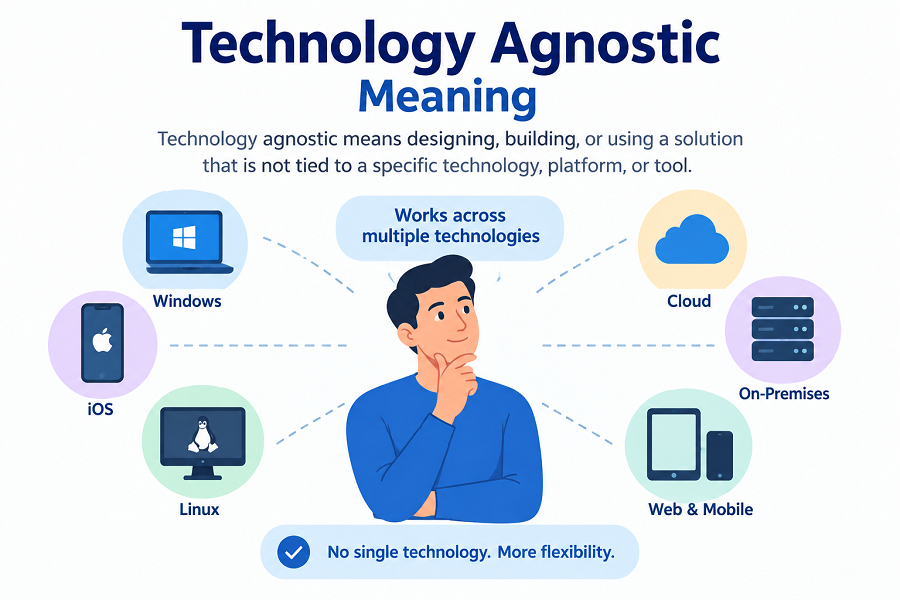
The term “technology-agnostic” refers to an approach in which a system, product, strategy, or solution is designed to work independently of a specific technology, platform, or vendor.
In simple terms, a technology-agnostic solution does not rely on a single technology. It can adapt and work with different tools, platforms, or environments.
For businesses in India and worldwide, technology-agnostic approaches help improve flexibility, reduce dependency, and support long-term digital growth.
What Does Technology Agnostic Mean?
Technology agnostic means not being tied to a particular technology or platform.
A technology-agnostic system focuses on achieving a goal rather than depending on one specific technical method.
For example:
A company wants to build a mobile application.
A technology-dependent approach may choose only one framework and design everything around it.
A technology-agnostic approach focuses on:
- User requirements
- Business goals
- Data management
- Security
- Performance
The application can later be adapted to different technologies if needed.
Simple Example of Technology Agnostic Approach
Imagine a business stores customer information.
A non-technology-agnostic approach may rely solely on a single database system.
If that database becomes expensive or outdated, migration can become difficult.
A technology-agnostic approach may use:
- Standard data formats
- Flexible architecture
- APIs
- Interoperable systems
This allows the business to switch technologies more easily.
Technology Agnostic vs Technology Specific
| Dependency | Works with multiple technologies | Depends on one technology |
| Flexibility | High flexibility | Limited flexibility |
| Migration | Easier to change platforms | Difficult migration |
| Cost Management | More options available | Vendor dependency may increase costs |
| Long-Term Use | Better adaptability | May become outdated faster |
Examples of Technology Agnostic Solutions
Cloud Computing
Many businesses design applications that can run across different cloud environments.
For example, a technology-agnostic cloud strategy may allow applications to operate across:
- Public cloud platforms
- Private cloud systems
- Hybrid environments
This reduces dependence on a single provider.
Programming Languages and Software Development
Developers often create applications using principles that allow future technology changes.
Examples include:
- Using open standards
- Building modular systems
- Creating APIs
- Separating business logic from technology layers
This makes software easier to maintain.
Data Storage Systems
A technology-agnostic data strategy focuses on making information accessible regardless of the storage platform.
Examples:
- Using common data formats
- Creating database-independent applications
- Supporting multiple data sources
Artificial Intelligence Systems
AI solutions can also follow technology-agnostic principles.
Instead of relying on a single AI model or platform, businesses can design systems that integrate with multiple AI technologies.
For example:
A company may build an AI application that can connect with different machine learning models depending on business requirements.
Importance of a Technology-Agnostic Approach for Businesses
Greater Flexibility
Technology changes quickly. A technology-agnostic approach allows companies to adopt new solutions without having to rebuild everything from scratch.
For Indian businesses experiencing rapid digital transformation, flexibility is especially valuable.
Reduced Vendor Lock-In
Vendor lock-in occurs when a business becomes highly dependent on a single technology provider.
A technology-agnostic strategy allows companies to:
- Compare different vendors
- Negotiate better pricing
- Switch solutions when necessary.
Better Long-Term Planning
Businesses can focus on future goals instead of short-term technology choices.
This helps organizations build systems that can grow with changing requirements.
Improved Innovation
When companies are not restricted to one technology, they can experiment with new tools and approaches.
This supports:
- Faster development
- Better customer experiences
- New digital products
Technology Agnostic Architecture
Technology-agnostic architecture is a system design approach that avoids unnecessary dependence on specific technologies.
Key principles include:
Modular Design
Systems are divided into independent components that can be updated separately.
Open Standards
Using widely accepted standards improves compatibility.
API-Based Communication
APIs allow different software systems to communicate regardless of their underlying technology.
Separation of Concerns
Business requirements remain separate from technical implementation.
Technology Agnostic in India’s Digital Ecosystem
India’s technology sector is rapidly adopting flexible digital solutions.
Technology-agnostic approaches are useful in areas such as:
Banking and FinTech
Financial companies use flexible systems to support:
- Mobile banking
- Digital payments
- Multiple financial platforms
Healthcare Technology
Hospitals and healthcare platforms benefit from systems that can connect with different:
- Medical software
- Data systems
- Digital health tools
Government Digital Services
Large-scale digital platforms require systems that can support millions of users and adapt to future technology changes.
Startups
Indian startups often prefer flexible technology strategies to scale quickly and adapt to market changes.
Advantages of Technology Agnostic Software
Technology-agnostic software provides several benefits:
Easier Integration
It can connect with different systems and applications.
Better Scalability
Businesses can expand without completely replacing existing systems.
Lower Risk
Companies are less affected by technology failures or provider changes.
Longer Technology Life
Solutions remain useful even when individual technologies become outdated.
Challenges of a Technology-Agnostic Approach
Although technology-agnostic strategies provide many benefits, they also have some challenges.
Higher Initial Planning
Creating flexible systems requires careful architecture planning.
Additional Development Effort
Developers may need more time to create adaptable solutions.
Performance Trade-Offs
In some cases, highly specialized technology may provide better performance than a general solution.
Technology Agnostic vs Technology Neutral
These terms are often used together but have slightly different meanings.
| Technology Agnostic | Designed to work without depending on specific technology |
| Technology Neutral | Does not favour one technology over another |
A technology-agnostic solution is usually technology-neutral, but it prioritizes adaptability and independence.
How Businesses Can Adopt a Technology Agnostic Strategy
Focus on Business Requirements
Companies should first define their goals rather than immediately selecting technology.
Use Open Standards
Open standards improve compatibility between systems.
Build Flexible Systems
Modular architecture makes future changes easier.
Avoid Excessive Vendor Dependency
Using multiple options reduces business risks.
Review Technology Regularly
Companies should evaluate whether current solutions still meet their needs.
Internal Link Opportunities for intechsslaash.com
Suggested internal links:
- Digital Transformation Trends in India
- Cloud Computing Explained: Benefits and Future
- Artificial Intelligence Applications in Business
- Software Development Trends in 2026
- What Is API and How Does It Work?
- Future Technology Trends in India
Conclusion
The term “technology-agnostic” describes an approach in which systems and solutions are designed without depending on any specific technology, platform, or vendor. This approach helps businesses achieve greater flexibility, reduce risks, and adapt to future innovations.
As technology continues to evolve rapidly, technology-agnostic strategies are becoming increasingly important for organizations, startups, and enterprises. By focusing on business needs rather than specific tools, companies can build solutions that remain valuable for the long term.
FAQs About Technology Agnostic Meaning
What is the simple meaning of technology agnostic?
Technology-agnostic means a system or solution can work with different technologies rather than depending on a single platform or tool.
Why is technology agnosticism important?
It helps businesses reduce vendor dependency, improve flexibility, and adapt more easily to future technology changes.
Is cloud computing technology agnostic?
Cloud systems can be designed using a technology-agnostic approach when applications are built to work across different cloud environments.
What is an example of technology-agnostic software?
Software built on open standards, APIs, and a flexible architecture that integrates with multiple platforms is an example of technology-agnostic software.
What is the difference between technology agnostic and technology-specific?
Technology-agnostic solutions work with multiple technologies, while technology-specific solutions are designed around one particular technology or platform.
Do startups benefit from technology-agnostic solutions?
Yes. Startups can benefit from flexible systems, which enable easier scaling, faster innovation, and simpler adoption of new technologies.